

Sin cities and the "lazy" cosmopolitan
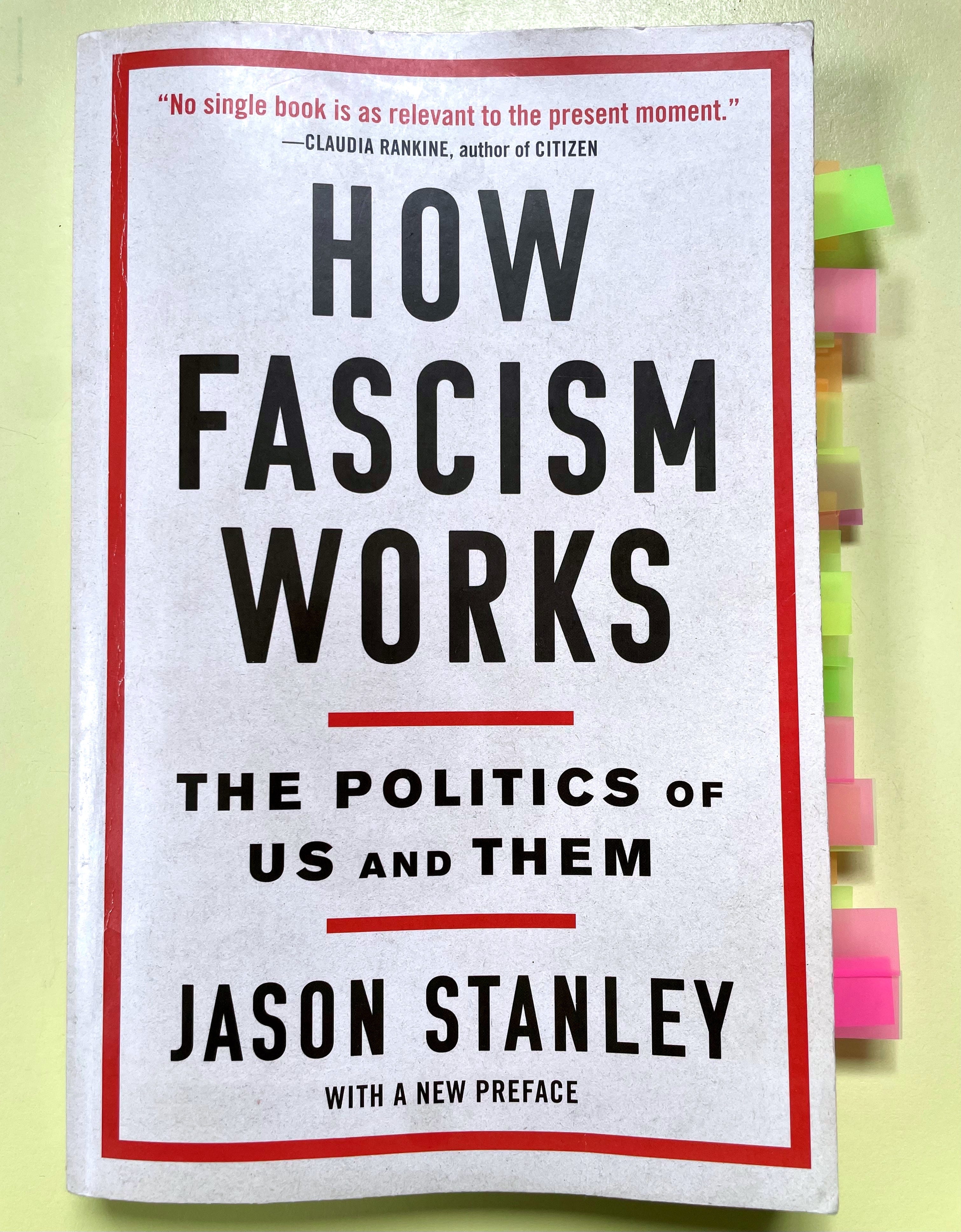
Brave Book Club | How Fascism Works | The final chapters

“Cities have long been treated, in rhetoric and literature, as places of decadence and sin.” —Jason Stanley
Last time on the Brave Book Club…
… we learned about Law & Order and Sexual Anxiety as tools in the political toolbox of fascism.
Catch up on those chapters here.
This week, we reach the end of How Fascism Works!
Chapter 9: Sodom & Gomorrah
I’ve never read Mein Kampf. Don’t think I ever will. And it’s been a strange experience, in the course of reading How Fascism Works, to be given little excerpts from this book that has always felt heavily shrouded in dark taboo, as if to open it would release more of its evil into the world. But, just as in The Wizard of Oz, the man behind the shroud is revealed to be small and sad.
I learned, through Jason Stanley’s chapters, that Hitler left his idyllic hometown, which he describes in M.K. with all the fascist mythologizing we’ve read about up until now—his hometown was made up of real people, real values, the “true” nation, blah blah blah. And yet, he wrote, “with a valise full of clothes and linen I went to Vienna full of determination.” Why would he leave such a perfect town, you ask? “Poverty and stern reality,” he wrote. Huh.
Though he needs what the city offers, he complains that cities are a kind of social deformity, where the population outgrows its ability to support itself from the land, as those in rural communities did. He is further repulsed by the diversity he encounters there, “the motley collection of Czechs, Poles, Hungarians …” (I’m sure you can guess where the list ends).
I imagine Hitler sitting in a gorgeous Viennese cafe, perhaps gorging himself on delectable Hungarian pastries, seething about the Hungarians who made them, like a burrito-obsessed immigration hardliner living near the Mexican border.

In fascist storytelling, the city creates a diluted, confused culture, full of sexual perversion—see the photo of wild depravity just above. Yes, sure, lots of cultures mix together in a city. But to stress-test that for a moment: Don’t the world’s cities give us some of our clearest and most globally beloved cultures? Take New York City & Brooklyn, Paris, Tokyo, London, or Buenos Aires, for a few obvious starters.
But in the fascist worldview, “the family-farm is the cornerstone of the nation’s values, and the family farm communities provide the backbone of its military.” Nazi policy sought to keep people from moving to cities—to keep them on their farms—and thereby remove the need for immigrant workers, thereby justifying xenophobic policies. One way to keep folks on the farm? Drum up scary stories about the big city, and also drum lots and lots of extra—perhaps excessive?—rural pride.
“The story flatters the voters whose support they need, and, like so many other aspects of fascist politics, it serves as another pretext to attack liberal democracy’s values of equality, pluralism, and diversity.”
That creates a big urban—rural divide, especially in attitudes toward immigration, which worked wonders for the Nazis’ political fortunes and has been powerful for Republicans in America. Stanley writes that during Minnesota’s 2014 elections, voters had a “pervasive sense that city dwellers were living off the taxes of the hardworking rural population.” In reality, the opposite was true. As in many states, Minnesota’s big cities were the economic engine that produced tax dollars that supported the rest of the state.
The fact that Republican/MAGA politicians have been lying about everything from crime rates (historically low) to economic reality in cities doesn’t matter—the story flatters the voters whose support they need, and, like so many other aspects of fascist politics, it serves as another pretext to attack liberal democracy’s values of equality, pluralism, and diversity.
There’s a feedback loop at play in cities: their opportunities draw in many people; the resulting larger and more diverse population creates anonymity and tolerance; this combination of tolerance and opportunity attracts more people.
Fascist politics targets financial elites, “cosmopolitans,” liberals, and religious, ethnic, and sexual minorities. In many countries, these are characteristically urban populations. Cities therefore usefully serve as a proxy target for the classic enemies of fascist politics.”
But this idea of the city-dweller living off the labor of farmers gets woven together with the racial diversity of urban centers to support and explain the mythological racial hierarchy at the heart of fascism. The fascist believes that the supposedly lazy minorities living in cities can be cured by being forced into hard labor.
Thus we reach Chapter 10: “Arbeit Macht Frei.”
Cities, with all their roads, schools, and fire departments, have greater infrastructure needs than a rural area, and more administration, more governance. More state. But to fascism, “the state is an enemy; it is to be replaced by the nation, which consists of self-sufficient individuals.” … i.e., those salt-of-the-earth farmers. Thus, the Nazis sought “to dismantle the state,” and with it the system of “welfare,” which supposedly perpetuated the dependency of undeserving groups.
Stanley writes that in American politics, the anti-welfare position is usually presented as a “desire for nurturing an ethic of self-sufficiency” and American individualism. But the research he has reviewed reveals what’s really motivating voters who oppose social programs. Maybe you can guess what it is?
The perception that blacks are lazy has a larger effect on white Americans’ welfare policy preferences than does economic self-interest, beliefs about individualism or views about the poor in general.
— Martin Gilens, “‘Race Coding’ and White Opposition to Welfare”
But the crucial information—I’d even call it a revelation—of this chapter is the pattern of fascist movements turning their us-versus-them myths into reality through their social policies.
In other words, by impoverishing, incarcerating, or mistreating targeted groups, fascist movements create the images of squalor, disorder, or dependency they were inventing all along.
A few examples:
This chapter quotes Hannah Arendt and Timothy Snyder’s writings about how Nazis accomplished this, displacing and impoverishing Jewish communities, which then created ghettos and refugees that governments were “forced” to deal with.
Frantz Fanon describes how the French similarly created a perverse reality for the Arabs they colonized in Algeria.
Similarly, in recent years, Myanmar “robbed [the Rohingya minority] of opportunities to work, and the constant harassment and policing … All of this served to reinforce negative stereotypes [and] legitimize the brutal and inhumane treatment of them.”
I’ll trust that most readers are at least somewhat familiar with America’s history of racialized policing and mass incarceration, and Nixon’s campaign of law & order, in combination with slashing the social safety net, all of which conspired to subjugate Black Americans to the lower rung of the hierarchy to which white supremacists believed they belonged. It’s a template MAGA is eager to employ again today.
Enough decades have passed that we’ve seen the data—as Stanley puts it, “no one can now claim ignorance of the effects of such a combination of policies, both on black Americans and on white racial attitudes.” It is not accidental or coincidental that these policies are being revived today—they seek to create the conditions they allegedly address, "so that politicians can continue to exploit fascist tactics for electoral gain.”

What could possibly save us?
It’s simple: Labor unions. When unions are strong and functioning well, they bring the artificially divided “us” and “them” groups together — and they reduce economic inequality! Two deadly conditions for a fascist movement.
A fascinating statistic in this chapter shows that inequality and union participation are strongly, inversely correlated. In fact, “the number of countries in the study with high inequality and high union density was zero.”
Parting Words
The epilogue of How Fascism Works wobbles between optimism and gloom. Democracy, Jason Stanley argues, “demands a great deal of all of us.” And, as past groups of citizens who supported their dictators clearly concluded, when they chose the moral abdication of following a demagogue, “there are easier ways to live.”
In contrast to the fascist’s effort to pit an “us” against a “them,” we can broaden our definition of “us.” How does that happen? Through education, experience, and exposure to people unlike ourselves. For so many, this world-broadening happens in college, when young adults from many different backgrounds suddenly form a new community and take on intellectual investigations.
But, Stanley asks, is America a place where this can happen? With college tuition ever further from reach for families—to say nothing of MAGA’s attacks on education at all levels—this critical education and experience becomes the privilege of the elite. If only the lucky few are encouraged to embrace ideals of tolerance, it leaves the majority of people more vulnerable to being seduced and manipulated by fascist political strategies.
But … is crying “fascism” an overreaction?
Don’t be distracted by this question, Stanley would advise. He points to psychological studies and historical evidence that, any time a democracy slides into fascism, there’s an observable process of normalization, which “makes us able to tolerate what was once intolerable.” For Americans today, we can think of how many hundreds of times since 2015 a political event has been described as “unprecedented.” The shocks of 2015, like a candidate refusing to release their tax returns, are no longer shocking. When extreme things eventually seem less extreme, the goalposts of what counts as extreme, what seems worthy of the term “fascism,” continually move.
The point is not to arrive at a final answer, like in a quiz in a teen magazine (Is This The Year Your Country Becomes Fascist?), but to be alert to the tactics—and consequences—of fascist politics.

Thank you for reading along!
If you followed along and now want to read the book yourself (do it!), I encourage you to get a copy from your local library or from the indie-supporting Bookshop.org.
What did you think of this experiment? Would you like to see another read-along, or perhaps a more traditional book club, with a video meetup? What would you like to read?
My thought is to pick something that deals with both the political stakes of this era and the act of creative and artistic expression. Like, Albert Camus’ Create Dangerously. How does that strike you? Hit reply or click the button to the send a message: